Back to List of Case Studies
Rethought Global Marketplace Onboarding to Achieve a 10-Fold Increase in Conversion Rate
Project Summary
Role: Product Design Lead & Hybrid PM
Scope: 0-to-1 systemic overhaul of a fragmented global B2B ecosystem.
The Design Scale: Architected a Universal Onboarding Framework that unified 70+ legacy marketplaces into a single, cohesive experience—designed to scale seamlessly as new marketplaces are added.
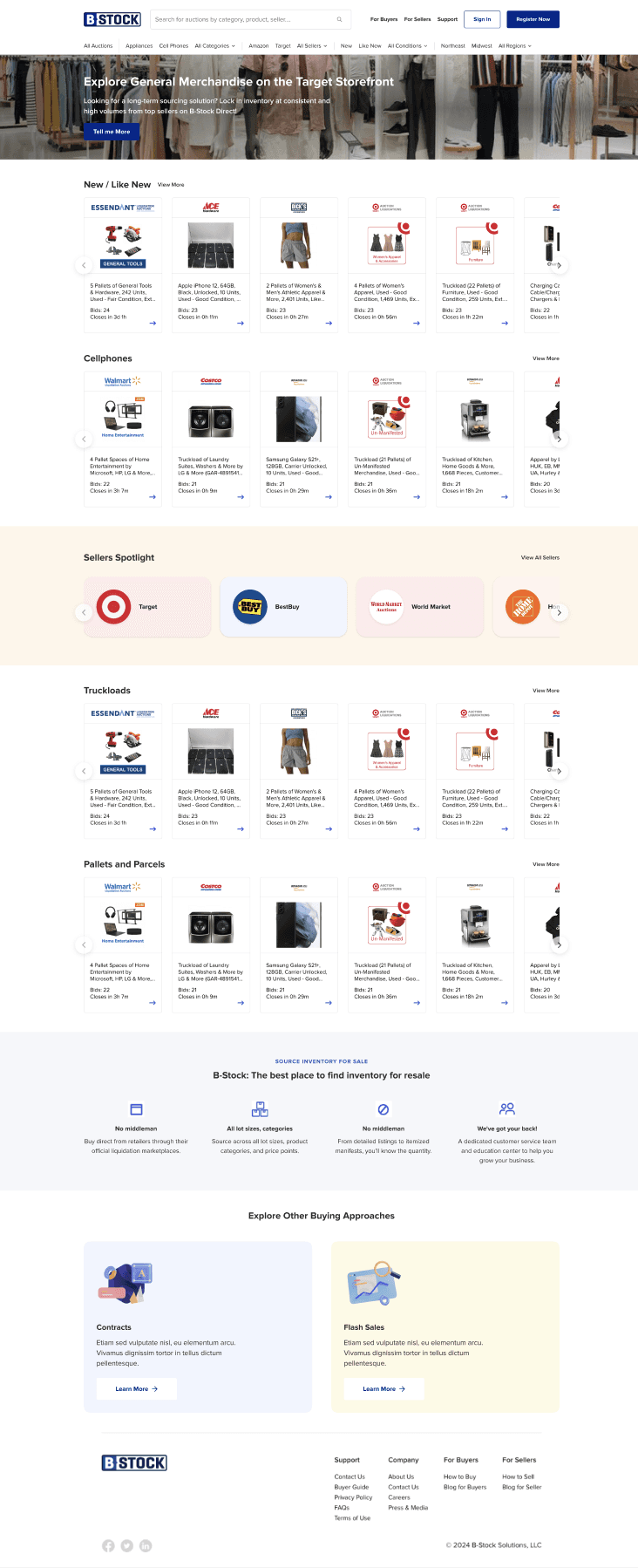
Top of Funnel Transformation: Redesigned the bstock.com entry point from a static corporate site into a Buyer-First Homepage and an "All Listings" Search Engine, allowing buyers to discover inventory across the entire network via a single Global Identity (SSO).
Key Innovation: Designed a Modular Onboarding System and a Contextual Logic Engine that dynamically surfaces requirements (Tax, Logistics, FF Letters) only when relevant.
Strategic Ownership: Defined the end-to-end product logic, reconciling complex global legal requirements with a frictionless, shoppable user experience.
Outcome: 10 fold Increase in Cross-Marketplace Conversion Rate, 80% Reduction in Support Tickets, Automated Approval: The end-to-end onboarding funnel now takes only 14 minutes (median), compared to the previous 24–48 hours.
Objective
To transform a fragmented network of 70+ isolated storefronts into a unified marketplace ecosystem by architecting a Global Identity (SSO) and automated compliance engine.
The Challenges
Platform Fragmentation & Discovery Barriers
The "Storefront Island" Problem: Our legacy architecture treated each of the 70+ marketplaces as a disconnected silo. Most buyers discovered us via SEO for specific retailers (e.g., "Walmart Liquidation"), leading them to believe they were joining a standalone portal rather than a network. Because credentials were scoped strictly to a single storefront, there was no "connective tissue" to lead users to the broader B-Stock network.
Static Entry Points: The Bstock.com homepage was a corporate information site rather than a commerce destination. It lacked active listings or a search utility, meaning high-intent buyers often bounced before finding a reason to register. Without a centralized "All Listings" view, buyers suffered from "Network Blindness"—data confirmed they failed to join other storefronts carrying the exact inventory they specialized in.
Zero New Partner Visibility: We lacked a mechanism to notify existing buyers when newly partnered retailers launched, forcing us to effectively re-acquire the same buyers for every new storefront launch.
The "Closed Door" Problem: Many marketplaces were gated, requiring high-friction registration before buyers could even see inventory. Without seeing the value first, users had no incentive to push through the difficult onboarding process.
The Friction & Fatigue Cycle
Redundant Data Entry: For the few users who did discover disconnected storefronts, the experience was prohibitive. They were forced to re-type identical business details and re-upload the same tax documents for every single application, leading to "document fatigue."
The Registration Cliff: Quantitative analysis revealed the physical limit of this fatigue: a "hard cliff" at 5 registrations where user stamina evaporated. Tellingly, zero users in the entire system were registered for more than 9 marketplaces. This created a mathematical ceiling on our network's growth.
The "Black Hole" of Drop-offs: Because we didn't capture contact info early (the "Quick Reg" problem), if a user abandoned the flow due to document fatigue, they vanished. We had no way to nurture these high-intent leads or help them complete the process later.
Operational Bottlenecks & Support Overload
Manual Latency: The approval process was entirely manual and took 24–48 hours. In a high-velocity auction environment where an auction might close in 4 hours, this delay killed buyer intent and caused them to miss the inventory they joined for.
Support Inefficiency: Vague requirements and confusing document requests led to a constant flood of customer support tickets. Users had to reach out to understand what was required, or our team had to spend hours manually chasing users to correct improperly provided information. This created a massive, unscalable operational burden.
The Compliance & Legal Paradox
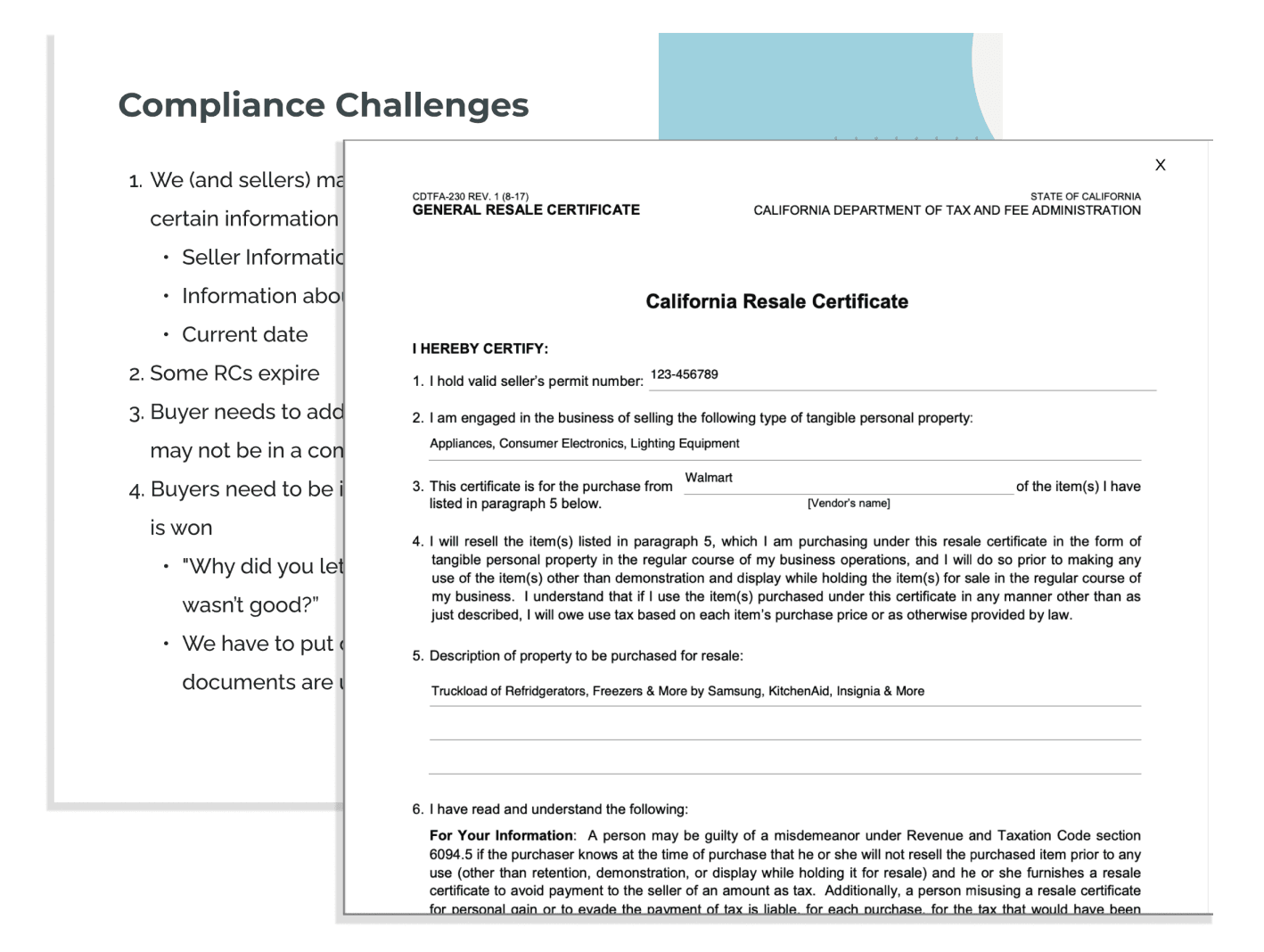
The Static PDF Limitation: Historically, the platform only collected a single, static PDF of a buyer’s Resale Certificate (RC). However, an RC is legally intended to be a specific agreement between one buyer and one seller. This created a significant "grey area" for a network model where one buyer was bidding across 70+ different marketplaces.
The Inaccuracy Risk: Because a single, generic document was reused for every seller, the RC rarely contained the specific seller's name or the actual category of goods being purchased. This meant that while a document existed, it was often legally inaccurate or insufficient for a formal tax audit.
Architectural Misalignment: Tax documentation was stored at the account level rather than the transaction level. If a buyer purchased from a seller ten times, there was only one generic document on file instead of the ten transaction-specific records required for full compliance.
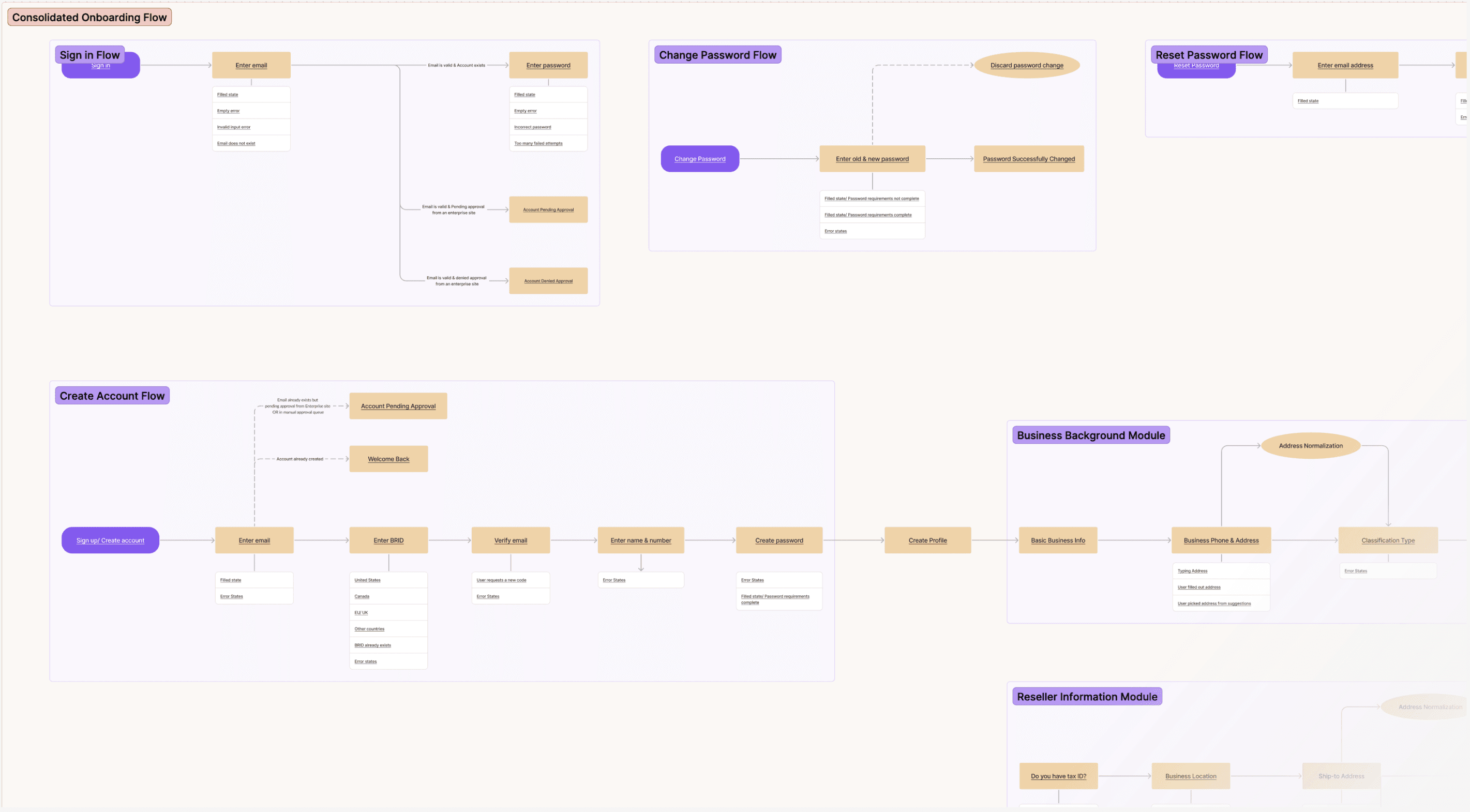
The Architectural Strategy: A Modular & Extensible Marketplace Funnel
I replaced 70+ fragmented silos with a Global Identity (SSO) so a buyer could register once from any entry point—the homepage, 'All Listings,' or a specific marketplace—and gain access to the entire ecosystem. I applied chunking to transform a daunting 'all-or-nothing' form into a modular onboarding flow, allowing buyers to focus on one area of their profile at a time.
1. Unified Discovery & Entry Points
We shifted the entry point from isolated login walls to commerce-driven pages to provide immediate value.
The Shoppable Homepage: I re-envisioned Bstock.com from a static corporate landing page into a buyer-focused e-commerce destination. By integrating registration directly into this central hub, I established a cohesive "multi-seller" experience that allowed buyers to recognize B-Stock as a unified marketplace network rather than a collection of disconnected portals.
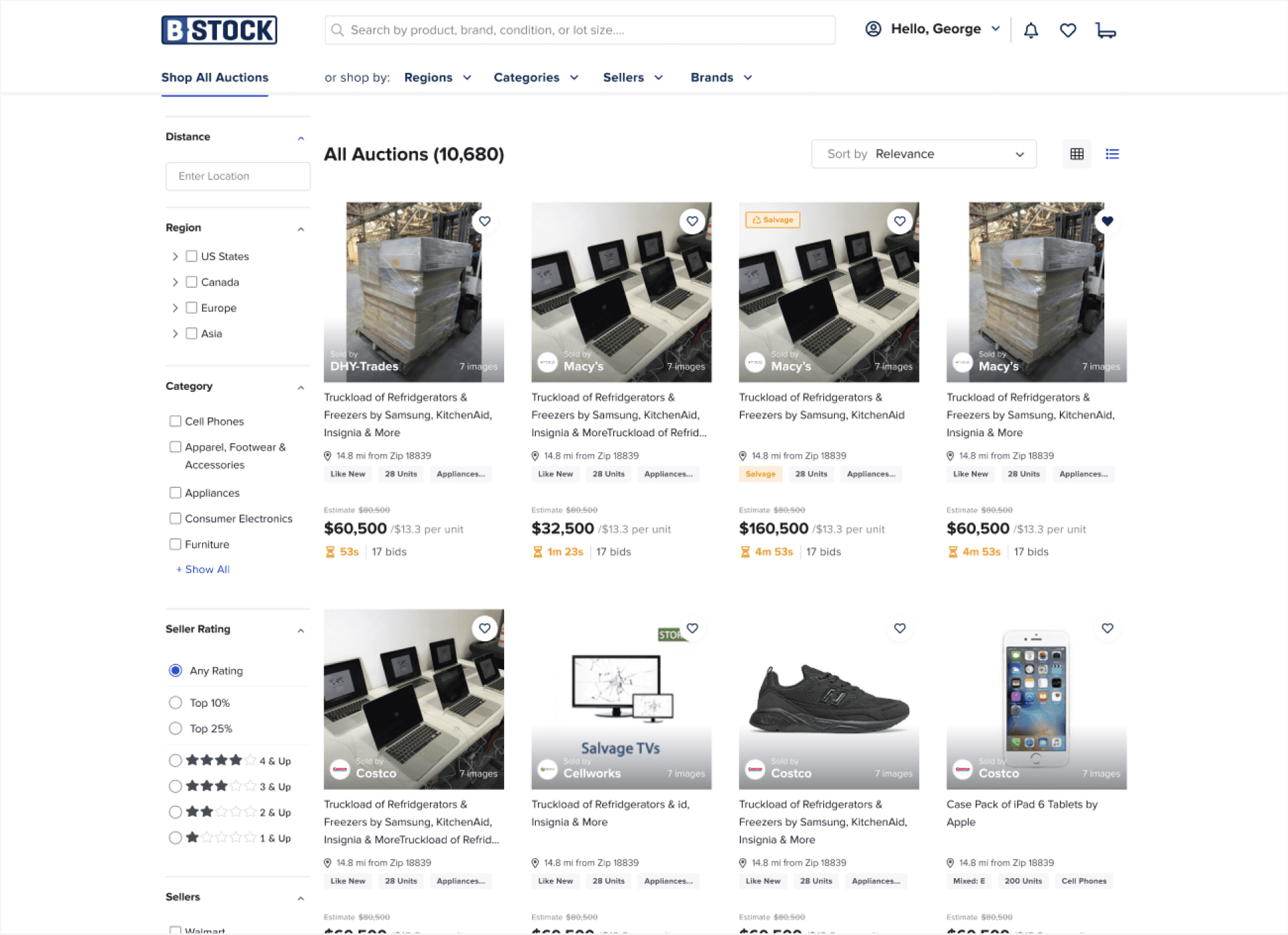
Centralized "All Listings" Search: I architected a global discovery experience that aggregated inventory from across the entire 70+ marketplace network. By allowing buyers to search by keyword and/or filter by specific criteria before registering, the page served as a powerful entry point where users could initiate global registration and gain immediate, cross-platform access.
Home Page: BEFORE
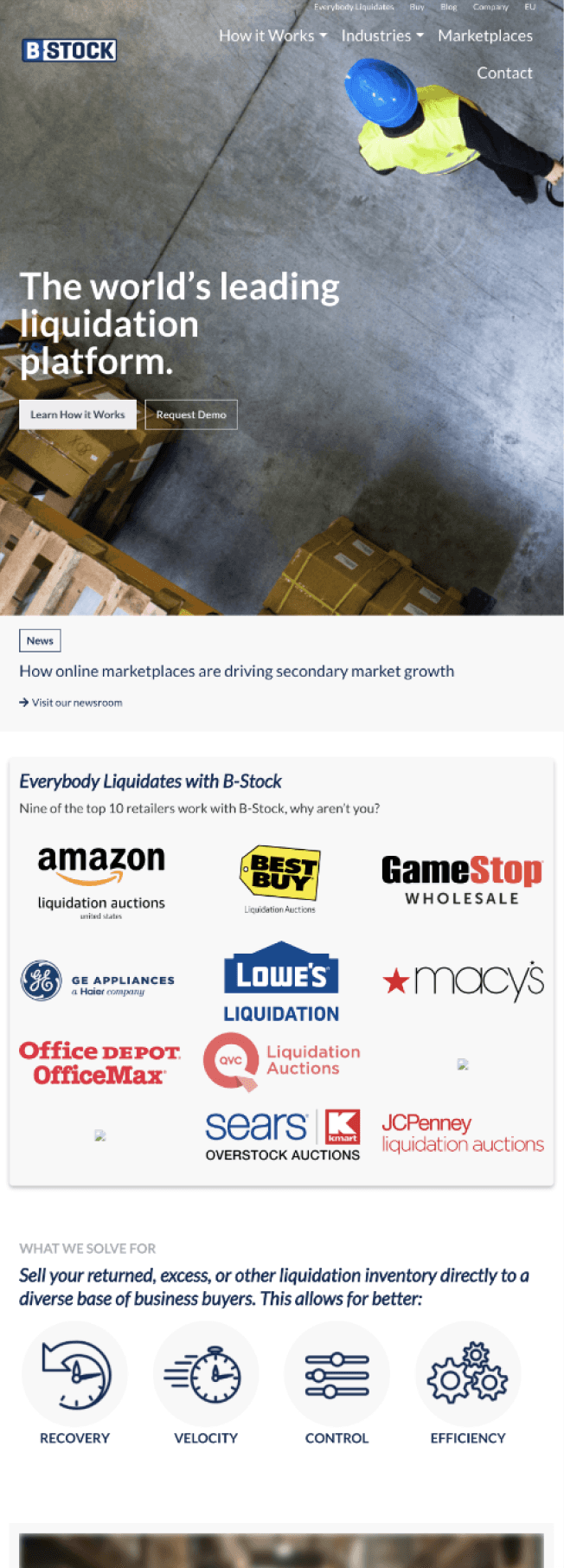
Home Page: AFTER
New All Listings Page - Looking Across Marketplaces
2. The Two-Tiered Funnel (The Chunking Strategy)
To solve the "Registration Cliff," I applied the principle of chunking to decouple account creation from heavy compliance documentation:
Quick Registration (Step 0): A light entry gate capturing only email and password. This secured the lead immediately, allowing the sales and marketing teams to nurture "abandoned" users who might have otherwise vanished into the "Black Hole" of the old long-form registration.
The 4-Module Structure: I reorganized the complex data requirements into four self-contained, skippable modules. This allowed users to explore the platform and build their profile at their own pace:
Module 1: Business Profile & Category Interest
Module 2: Tax, Resale Certificates & Logistics (Linking the shipping address to tax status and delivery constraints like dock access/liftgate needs)
Module 3: International Compliance (The Freight Forwarder framework to prove goods are leaving the country, exempting international buyers from domestic sales tax)
Module 4: Responsible Recycling (Capturing R2 certificates or signed recycling agreements required by electronics sellers)
Quick Registration

The 4 Modules

3. Adaptive Profile Completion I designed a multi-path system to intelligently collect remaining data and compliance requirements, allowing the system to adapt when users chose to defer the more complex onboarding steps.
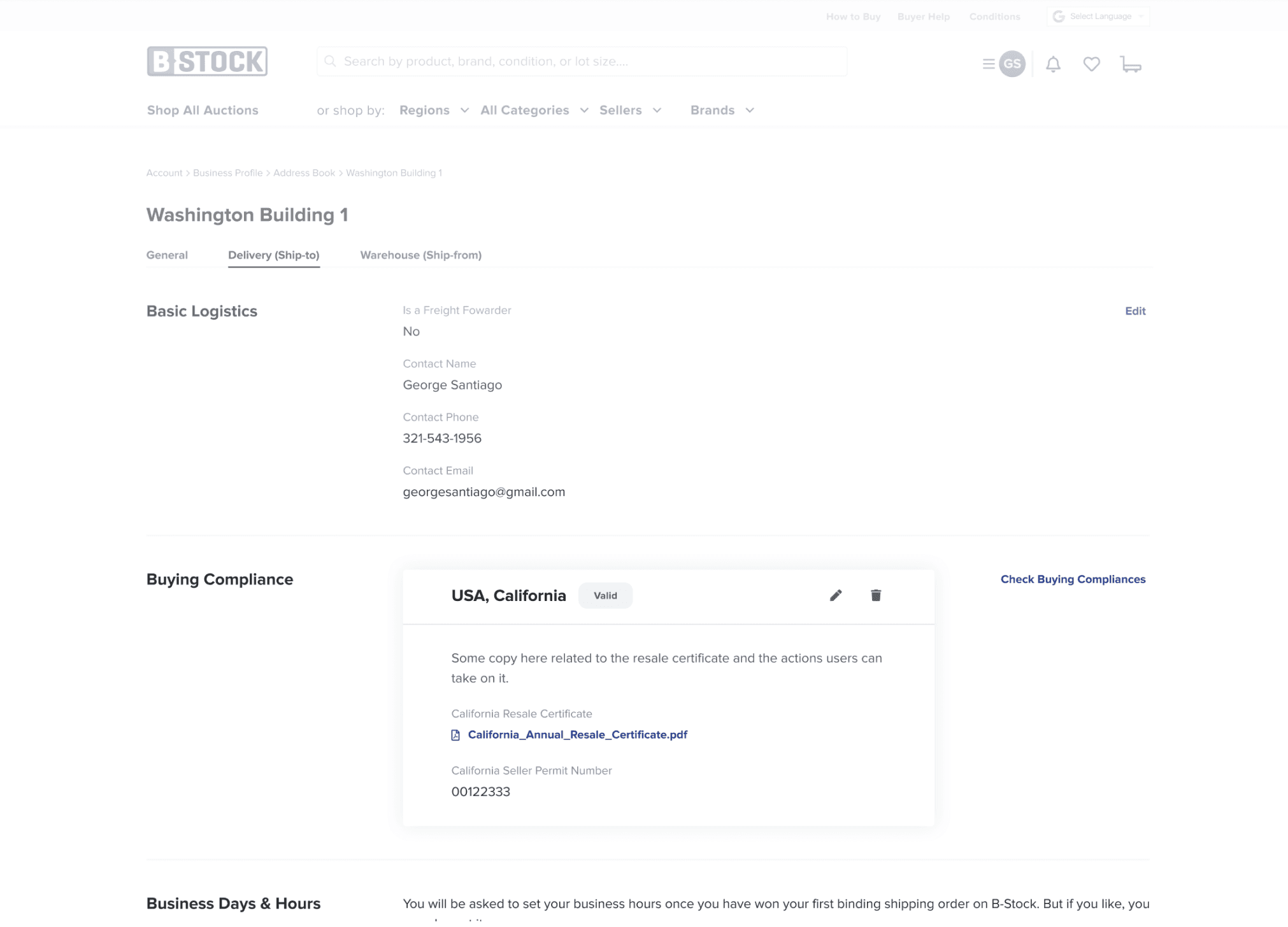
Contextual Persistence: I designed a persistent UI banner that acted as a "Status Tracker," surfacing only the missing requirements needed to become "bid-ready." While dismissible to ensure a frictionless browsing experience, the banner served as a constant, non-intrusive reminder of the user's progress.
The Intent-Based Gate: For users who chose not to engage with the banner, the system triggered a "Just-in-Time" compliance gate. This required missing data only at the moment of highest intent—such as when clicking "Place Bid"—ensuring that "hard" barriers only appeared when the user was most motivated to clear them.
The Self-Service Path: I redesigned the "My Account" and "Profile" sections to serve as a secondary hub where buyers could proactively manage or update their modules and documents at their own convenience.
Banner to re-engage users

Progressive collection of profile information at time of intent
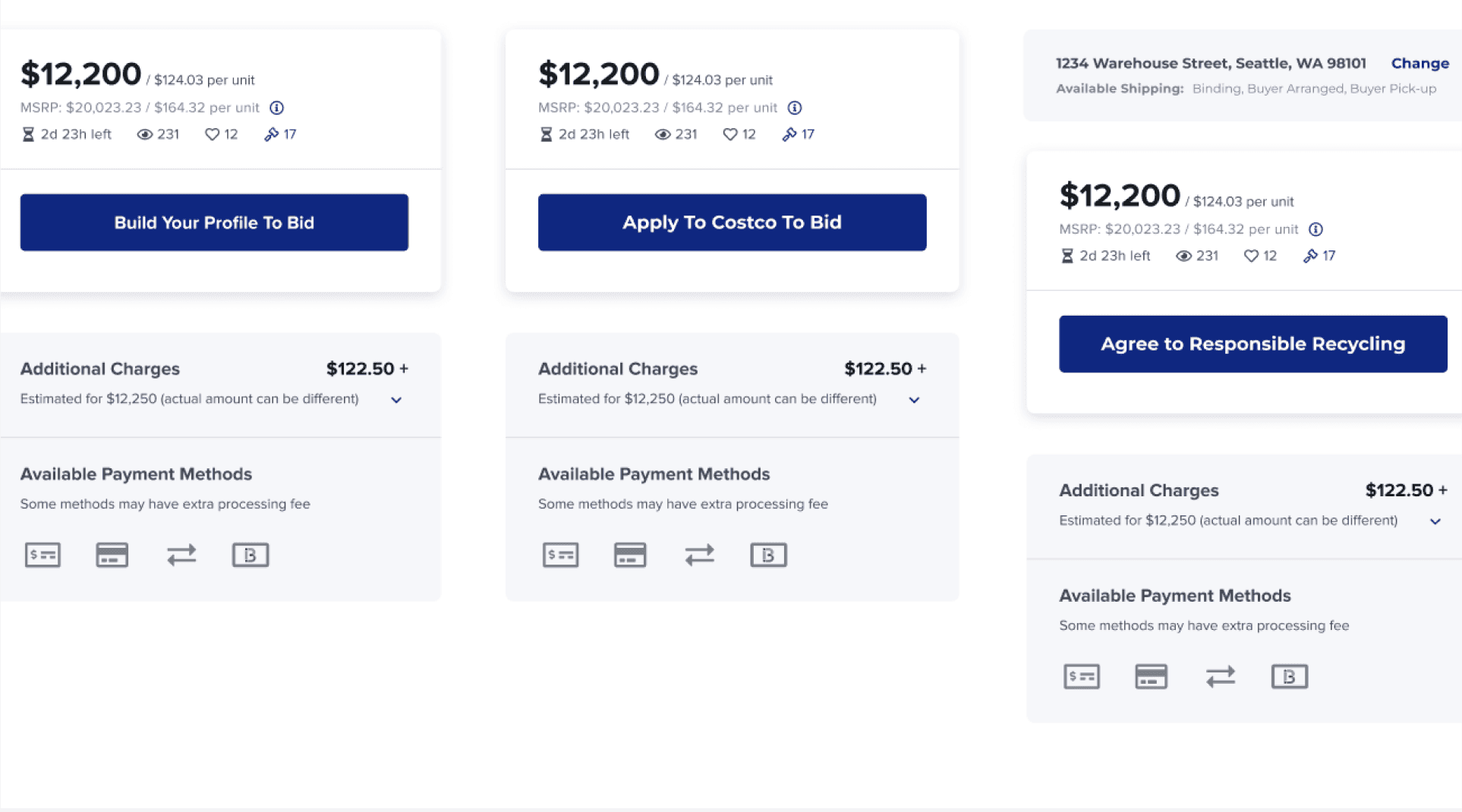
Profile information saved in My Account
Decisions in the Weeds
Designing at scale meant making constant decisions for best user experience while navigating complex business needs. The following selected examples are meant to show how I approached these decisions and how I managed the trade-offs required to keep buyers moving without compromising the system.
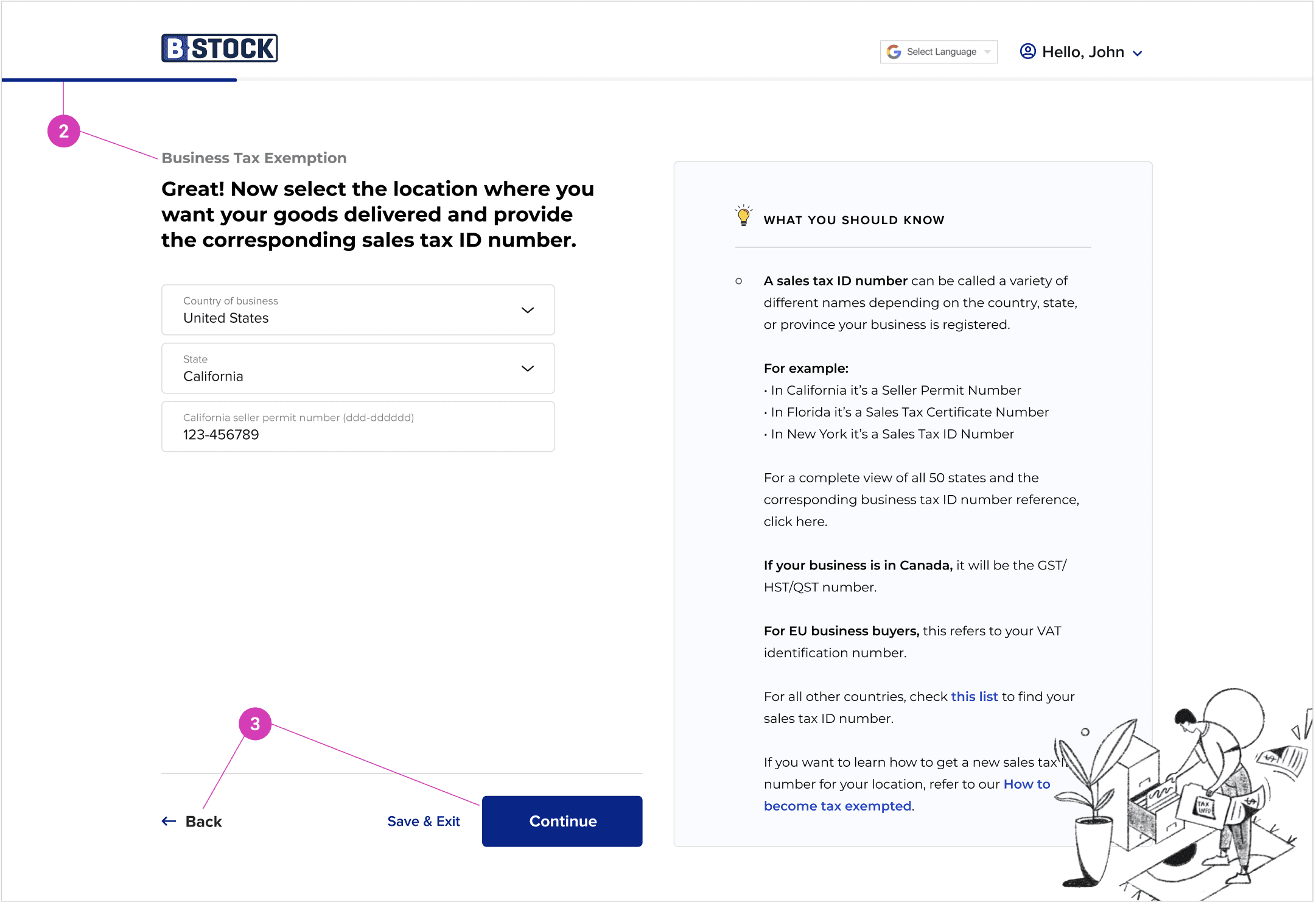
Sales Tax Compliance
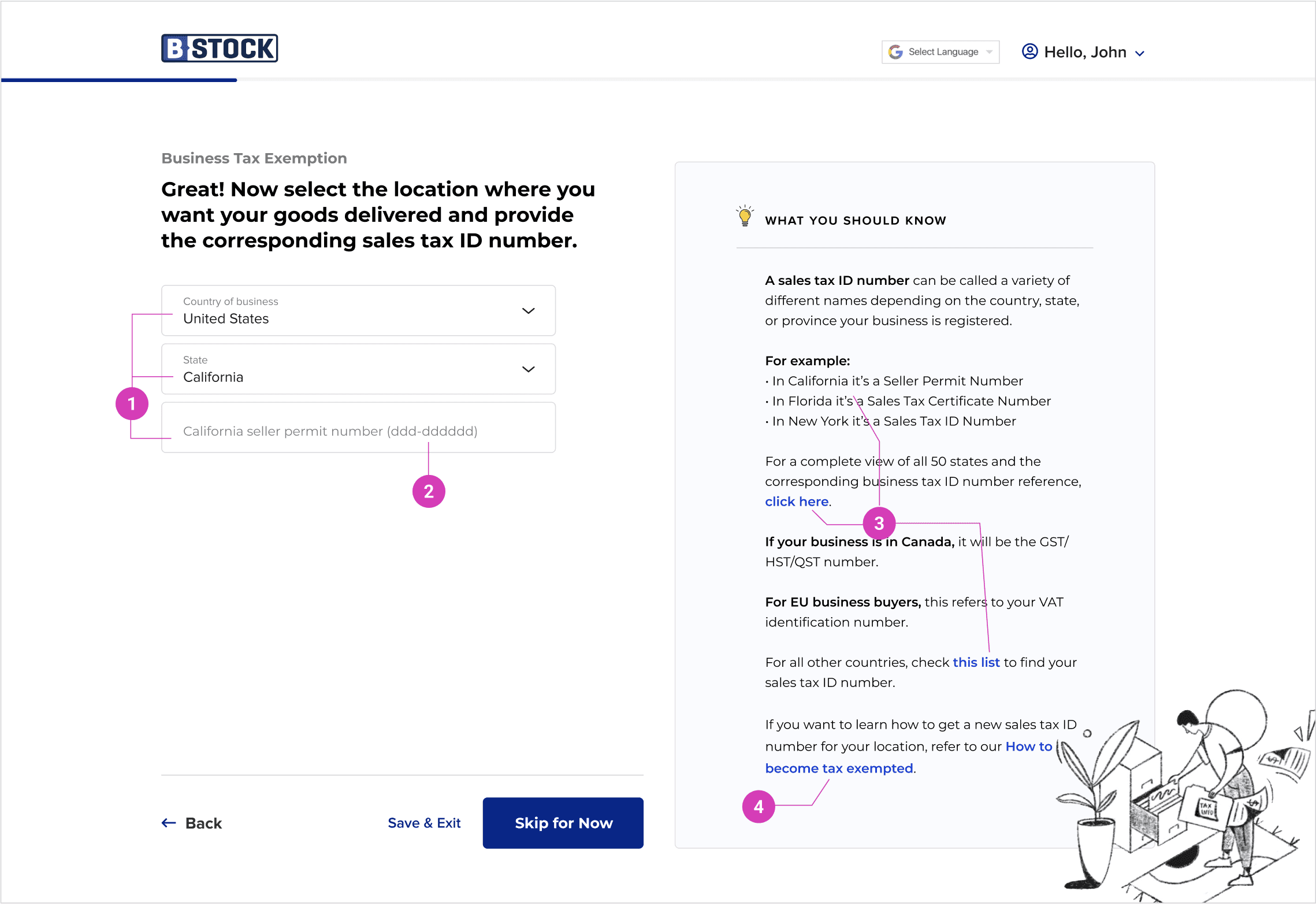
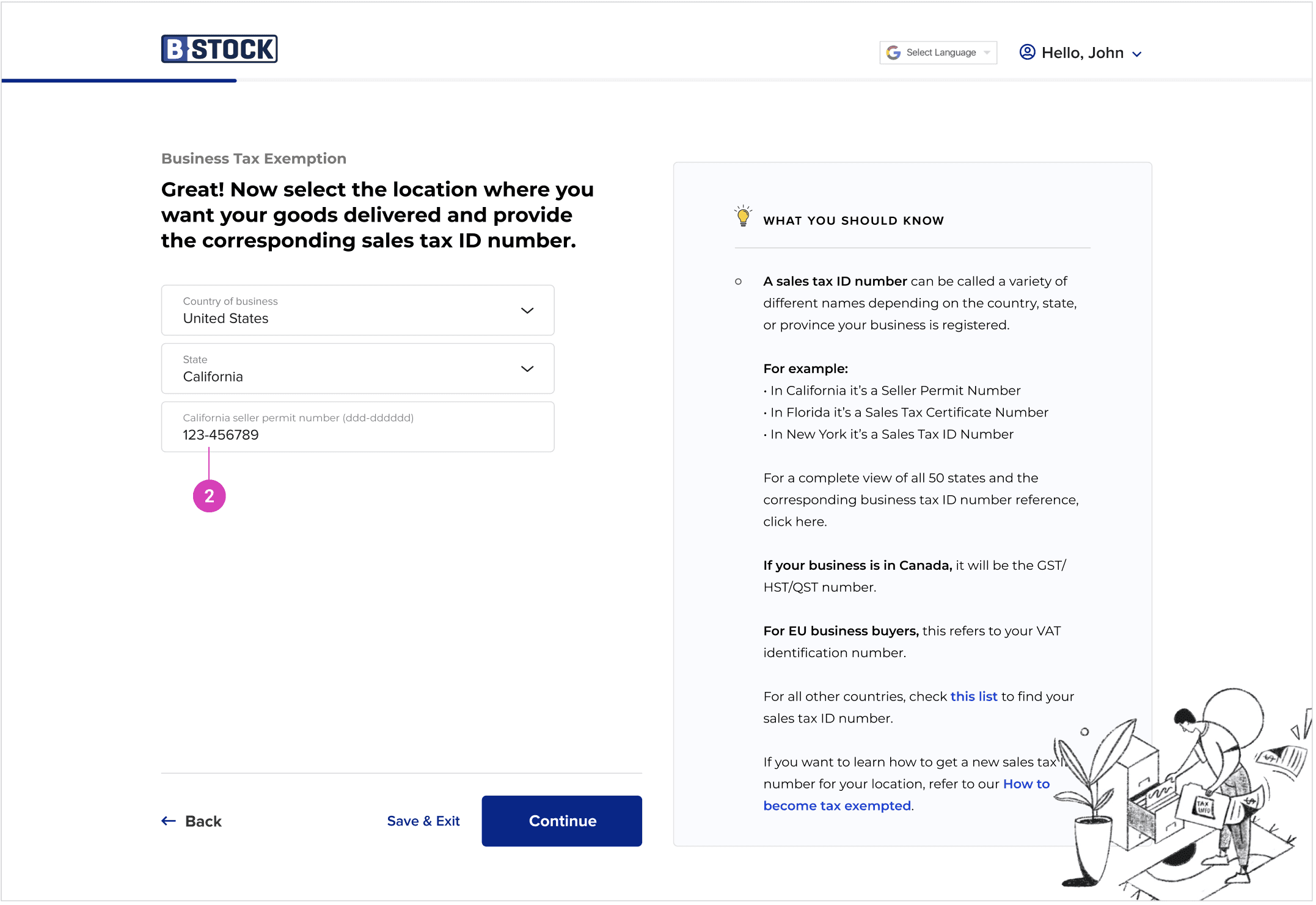
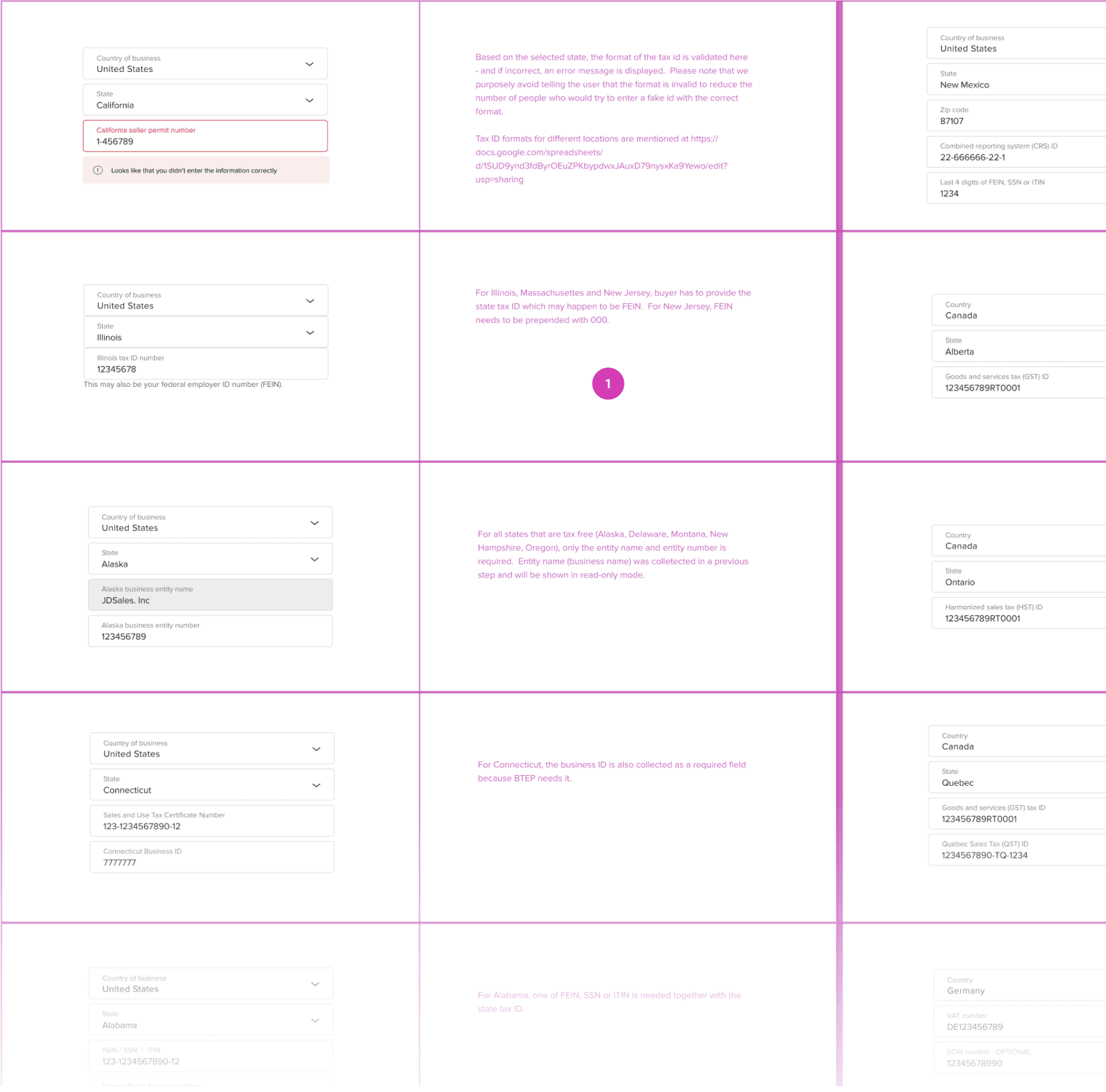
1
Context-Aware Tax Logic
The Decision: I restructured the form to progressively collect location data (Country > State) to dynamically surface a field that matches the specific document name for that region—like a "Seller's Permit" in CA or a "VAT Number" in the EU.
The Trade-off: While this required more complex backend logic, it replaced the generic "Sales Tax ID" label which users frequently confused with their FEIN or SSN. We traded a simple, static form for Precision, matching the UI to the physical certificate in the user’s hand to prevent abandonment.
2
The Evolution of Global Compliance
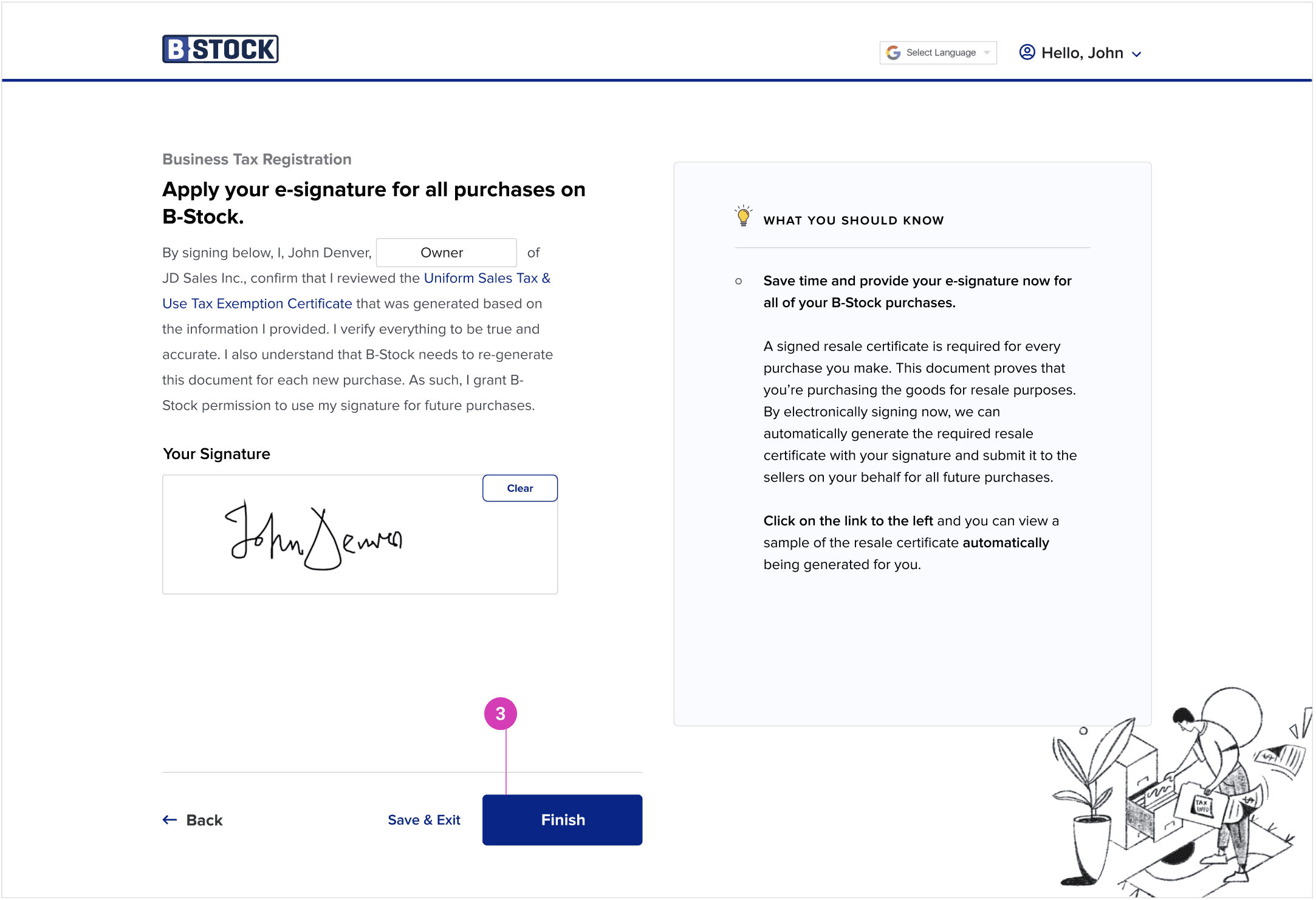
The Decision: I transitioned the onboarding process from a 48-hour manual review to an automated format-validation system, reducing approval times to minutes. When data later showed that hidden validation formats were still causing friction for some legitimate users, I pivoted to a Good Faith model—exposing the required formats to the user and shifting legal liability to them via a digital signature.
The Trade-off: We traded "Security by Obscurity" for User Velocity. While the initial automation solved the speed issue, the "Good Faith" pivot solved the remaining conversion hurdles. By architecting the system around format patterns rather than flat strings, I ensured the platform remained frictionless for users while staying "API-ready" for future government-database integrations.
3
Contextual Tax Education
The Decision: I utilized a persistent side panel to provide context-sensitive guidance, specifically educating users on why tax names change based on location (e.g., explaining that a "Seller’s Permit Number" in CA is functionally equivalent to an "Sales Tax ID Number" in NY).
The Trade-off: We traded minimalist UI for high-context clarity. By providing localized definitions and direct links to state-specific naming conventions, we eliminated the "Terminology Fog" and reduced support tickets. This kept the user in the flow even when they were unsure of their specific document's legal name.
4
The "Path to Exemption" (Growth Strategy)
The Decision: Rather than showing a dead-end to users without a tax ID, I integrated a guide explaining how to obtain an exemption certificate based on their specific location.
The Trade-off: We traded a fast, binary filter for a nurture-based conversion strategy. Instead of rejecting unqualified traffic, we treated "curious" users as future customers. By lowering the barrier to entry through education, we empowered casual users to become legitimate business entities, effectively growing the platform's long-term buyer pool.
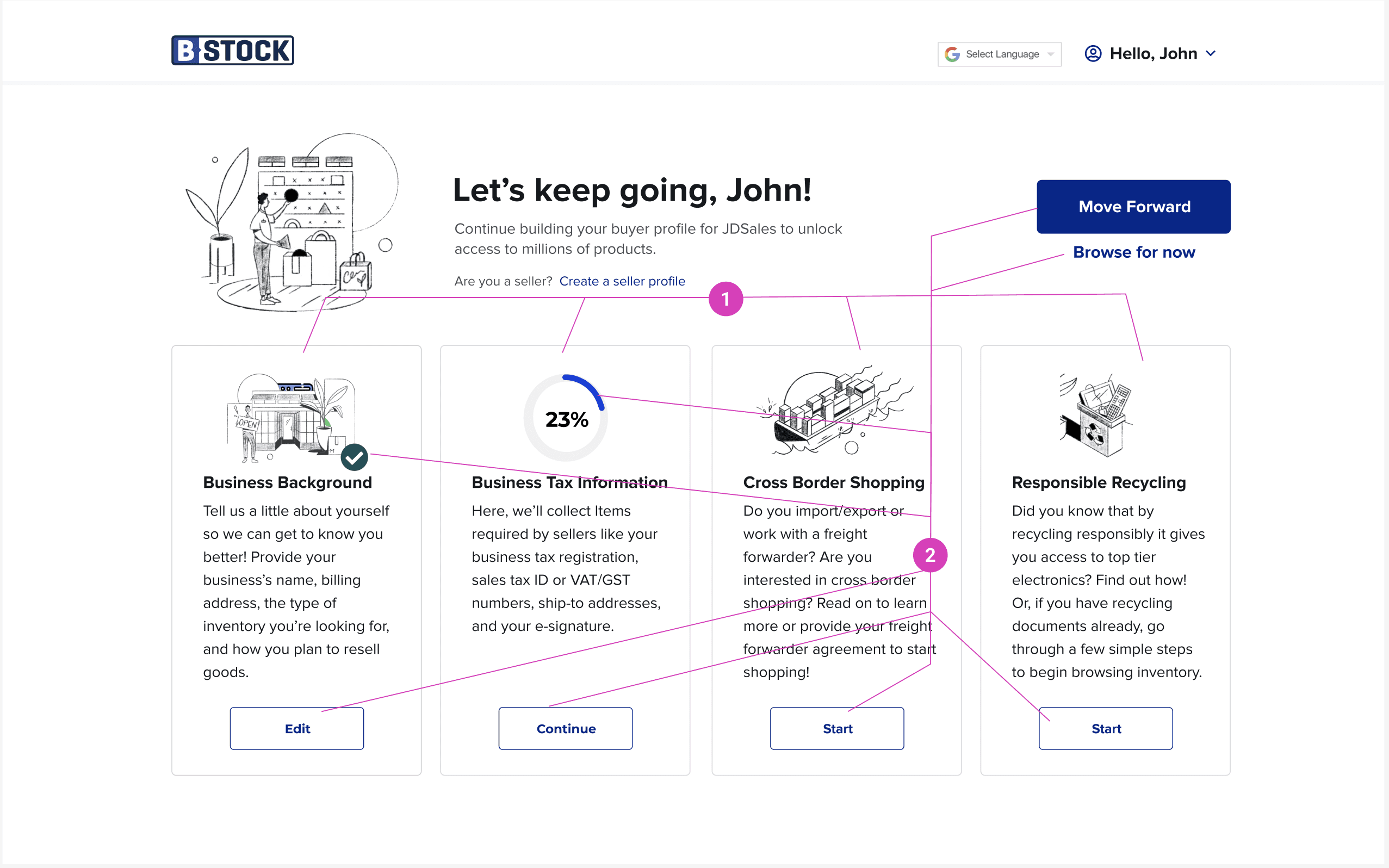
1
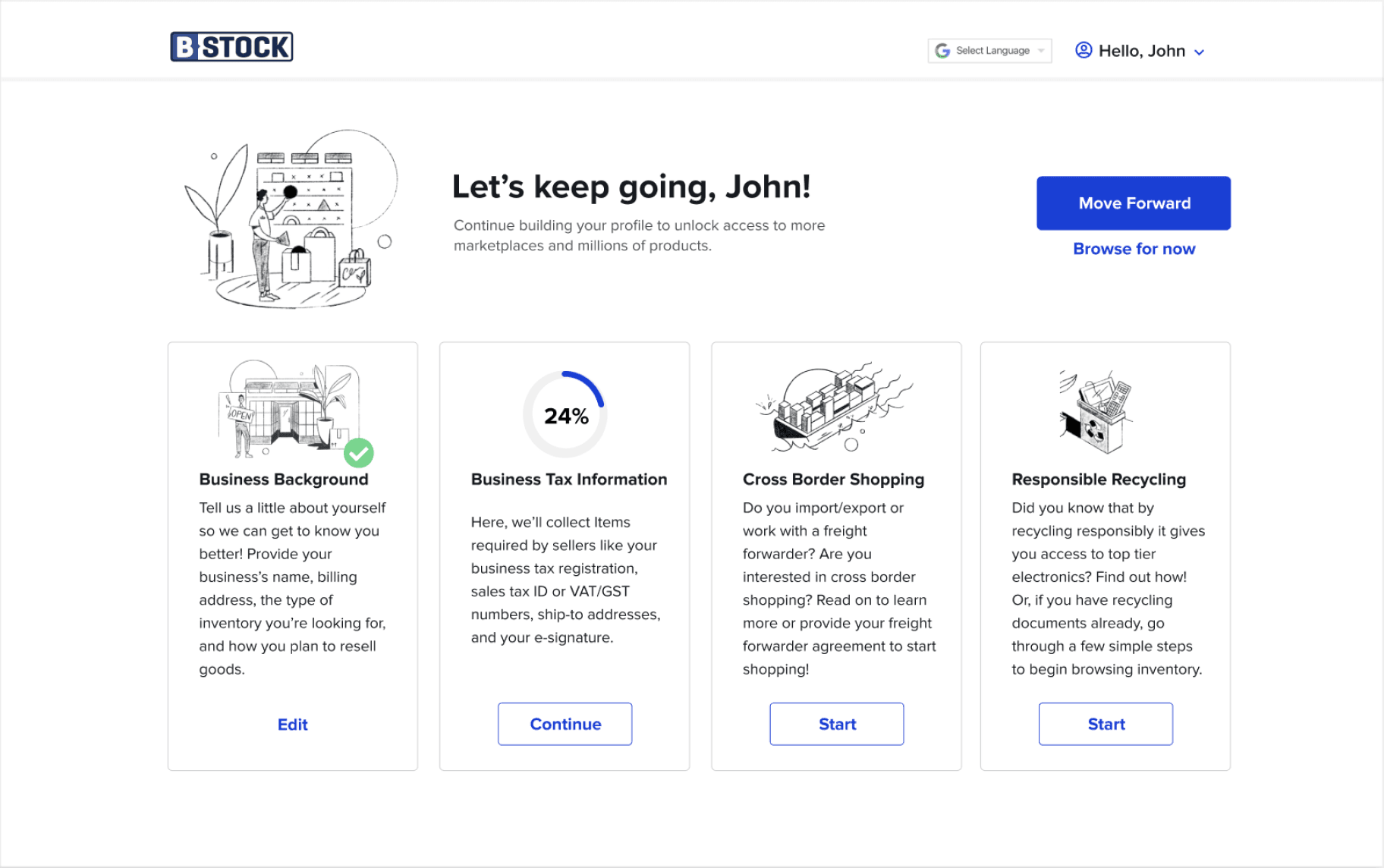
The Module Dashboard (The Landing Place)
The Decision: I designed a central dashboard that acts as the "home base" for the onboarding journey. It breaks the registration into four high-level cards, creating a necessary "landing place" where users can see the full scope of requirements before diving into the details.
The Trade-off: We traded linear momentum for task clarity. While adding a hub between modules creates an extra click, it transforms a daunting administrative task into a series of achievable milestones. My hypothesis—later validated by data—was that the psychological benefit of a "breather" and a clear overview outweighed the risk of drop-off typically feared with extra steps.
2
Visualizing Progress (Indicators & Actions)
The Decision: I implemented dynamic status indicators—Completion Percentages and Green Checkmarks within the module dashboard, and a persistent Progress Bar on internal pages—to communicate state. Alongside these, I provided contextual actions on the dashboard, including Start, Continue, or Edit, and a global "Browse for Now" option.
The Rationale: To eliminate "navigational fog," I used granular status tracking so users always know their exact standing across both the dashboard and internal flows. The trade-off centered on the "Browse for Now" button: while it technically introduces a "distraction" from the registration, I prioritized long-term engagement. Allowing users to see the platform’s value mid-process provides a constant incentive to return and complete the administrative tasks rather than feeling trapped in a linear funnel.
3
Persistent Navigation Bar
The Decision: The bottom navigation bar provides a consistent location for primary and secondary actions (Back, Continue, and Finish) throughout the onboarding experience.
The Rationale: This creates a stable interaction zone across different page lengths. By anchoring the navigation, the user has a predictable "next step" that never shifts, allowing them to move through modules with minimal visual search time.
4
Psychological Agency (Save & Exit)
The Decision: I included an explicit "Save & Exit" button in the persistent bar, despite the system having background auto-save functionality.
The Trade-off: We traded flow continuity for user peace of mind. While an explicit exit button could technically encourage a user to stop mid-session, I prioritized long-term retention over immediate completion. In complex B2B registrations, the "Will I lose my work?" anxiety is a leading cause of permanent abandonment. Providing a manual "Save" anchor gives the user the confidence to step away, knowing their progress is secure, which ultimately leads to higher return rates.
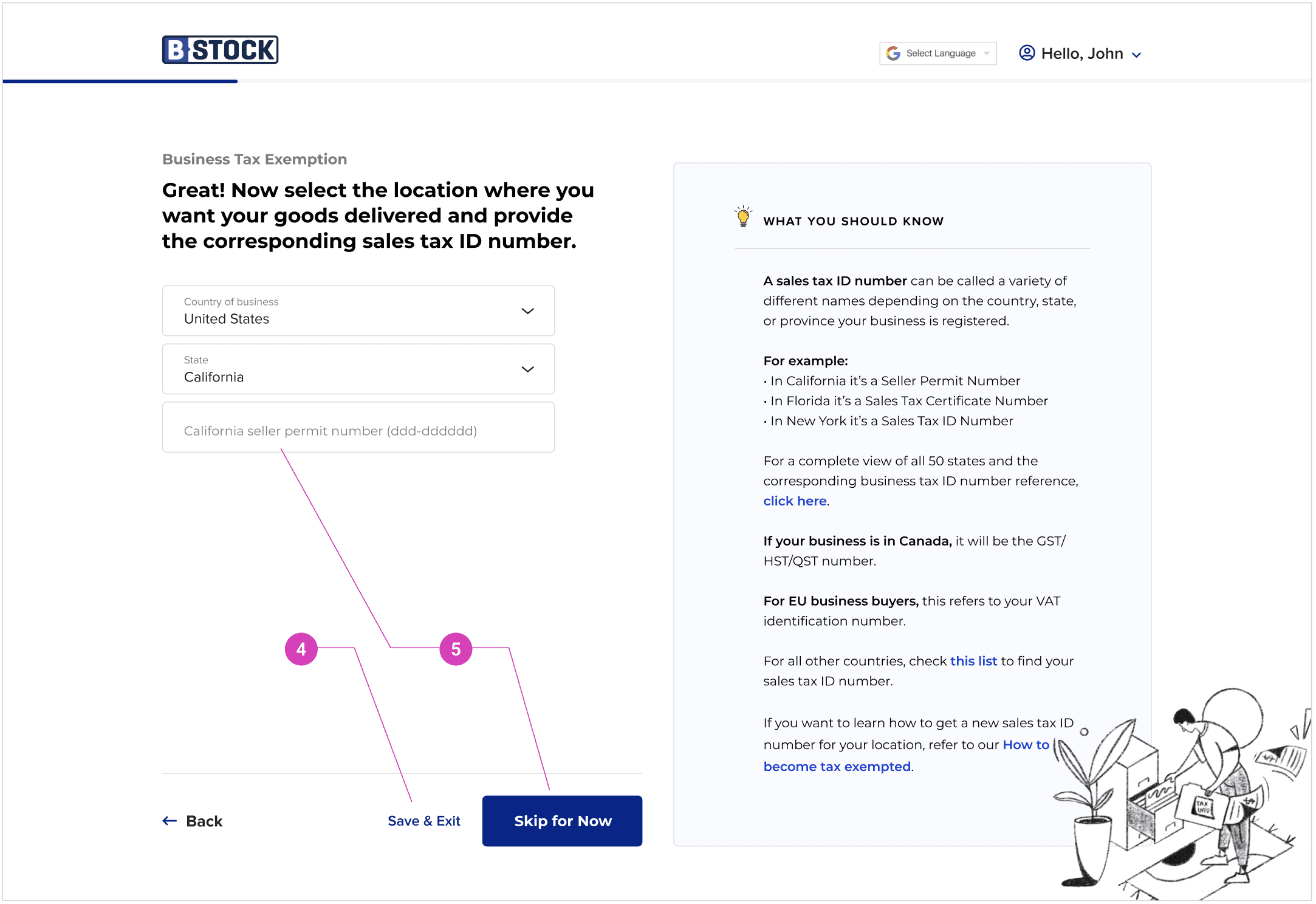
5
Momentum-First "Skip for Now"
The Decision: For sections requiring external documentation (such as Tax IDs or Business Licenses), I introduced a "Skip for Now" option that allows the user to progress even if they don't have those specific files on hand.
The Trade-off: We traded immediate data-completeness for onboarding velocity. While a "Skip" button could tempt users to bypass critical fields, I prioritized psychological investment. By allowing them to finish the "easy" tasks first, they reach a high level of completion (e.g., 90%) where they are far more likely to return later to provide the missing data than if they were blocked and forced to abandon the flow mid-stream.
Controlled Progress & Persistence
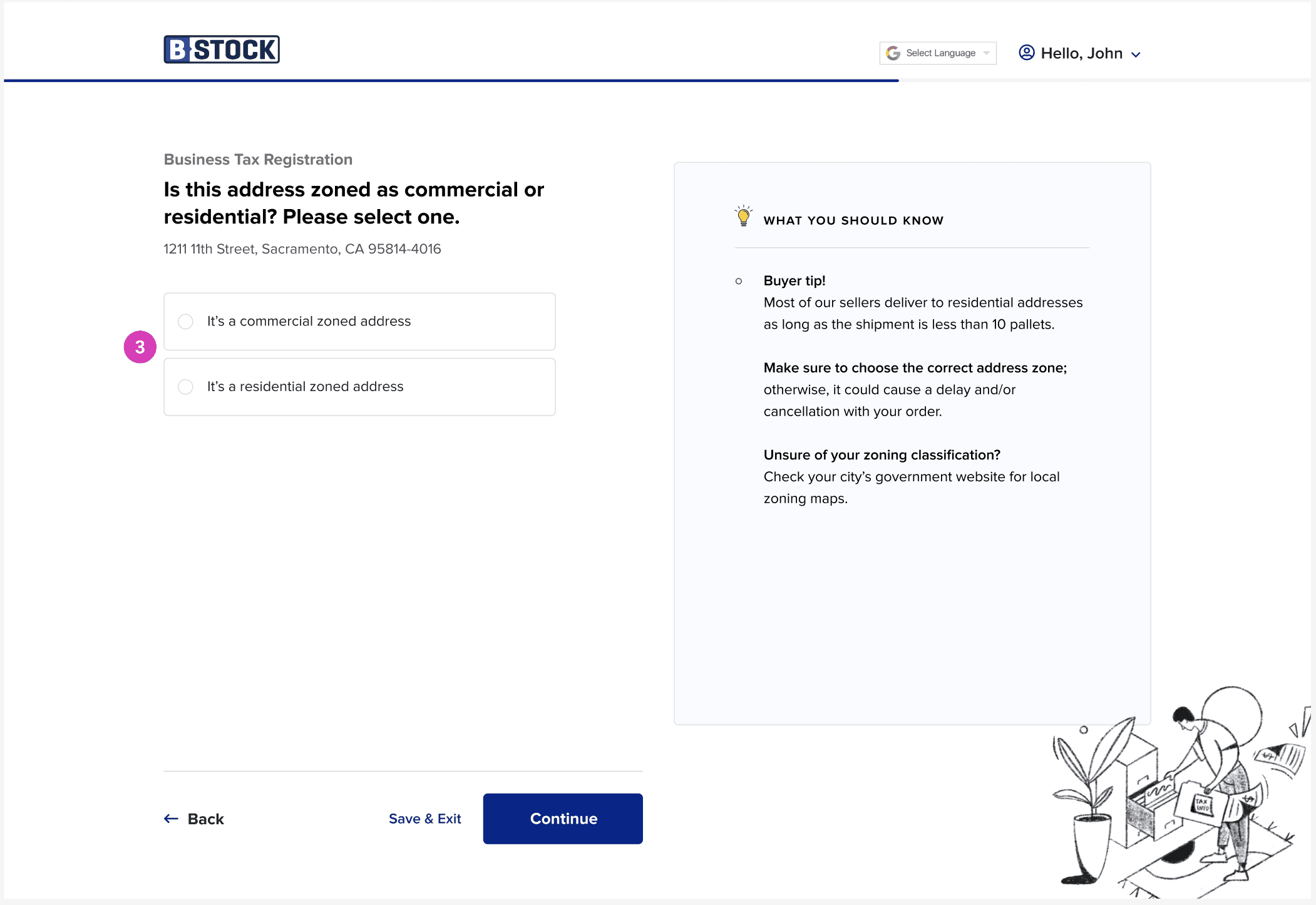
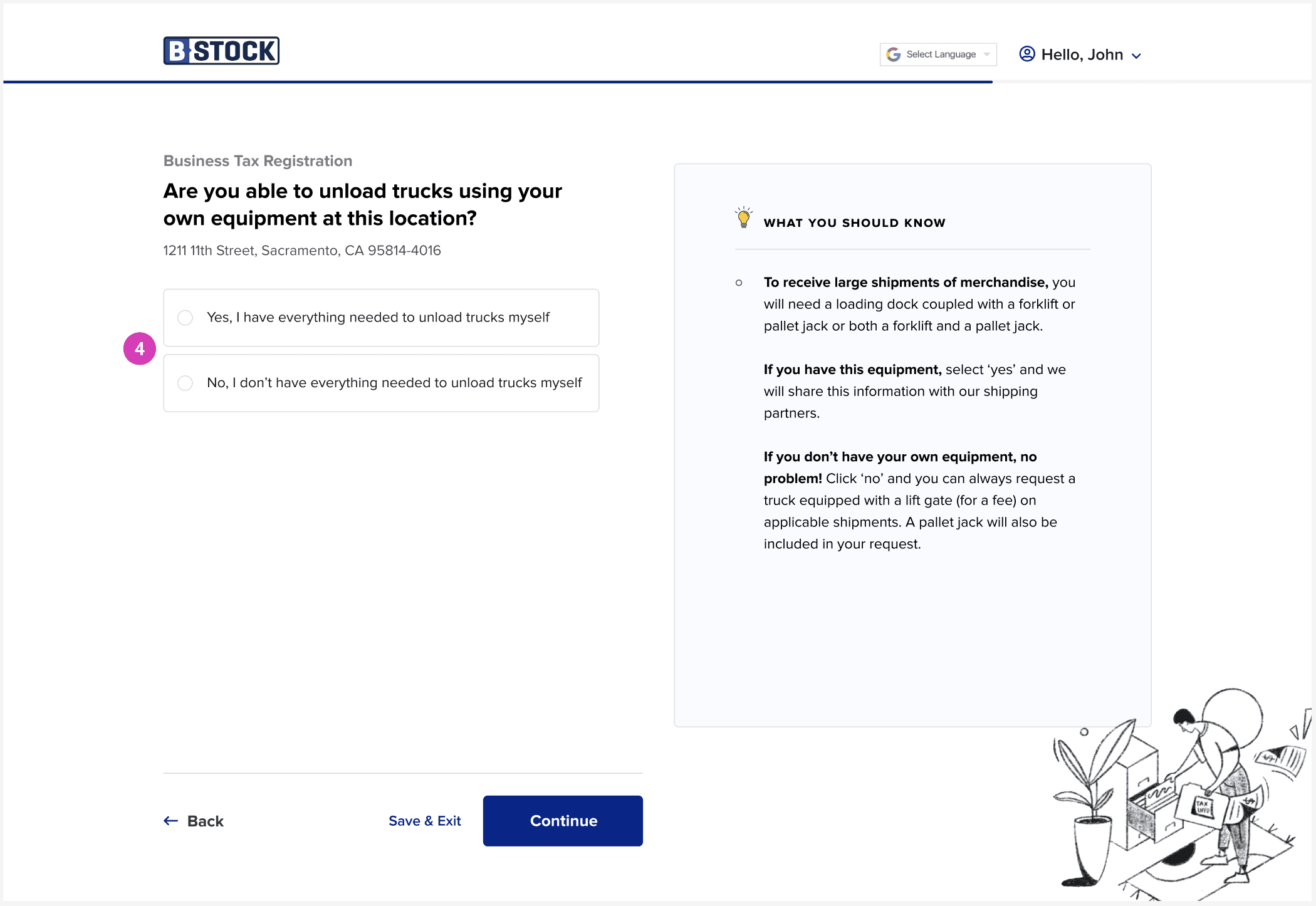
Ship-to addresses and Shipping Logistics
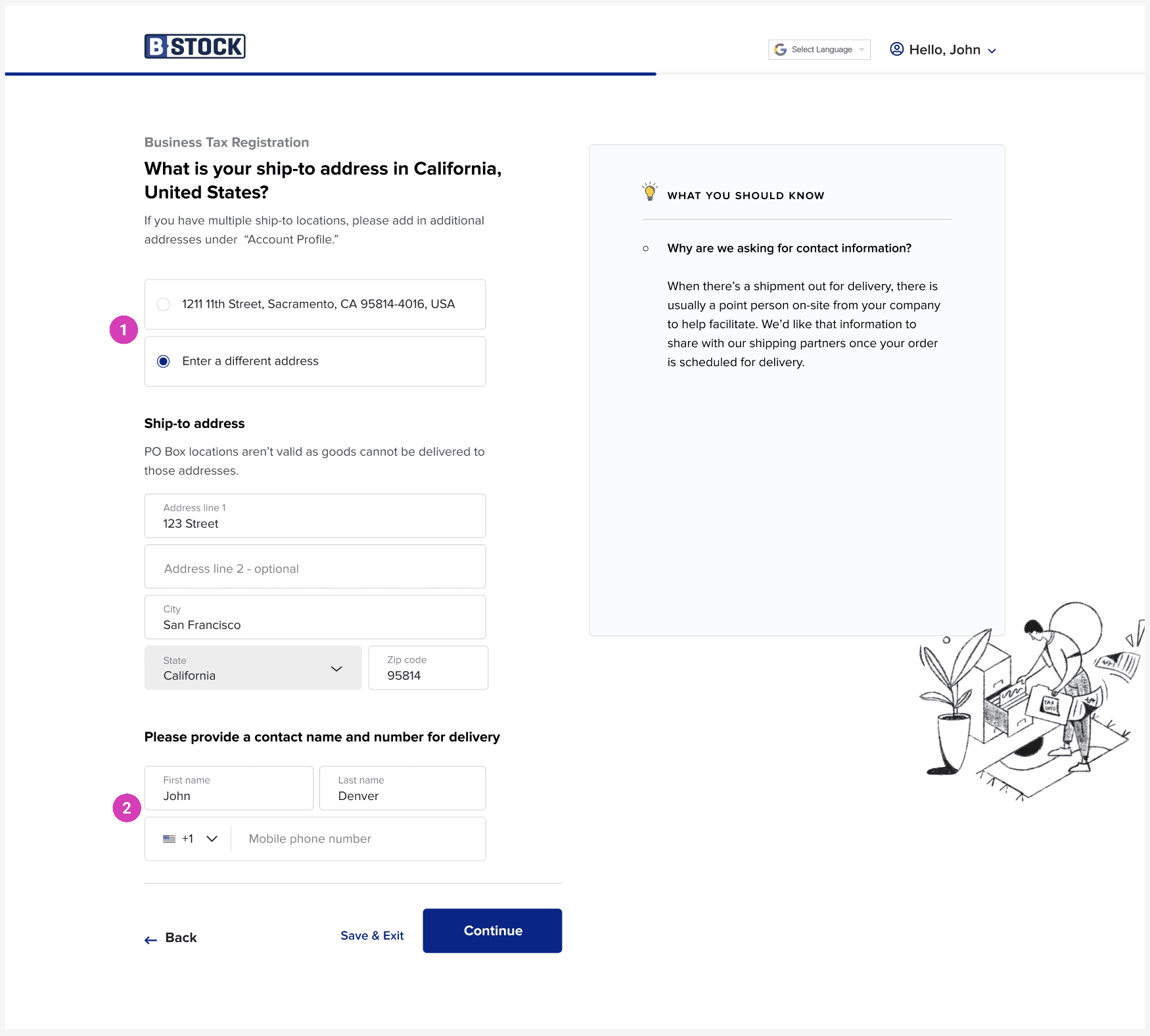
1
Self-Service Multi-Address Management
The Decision: I redesigned the address capture to support a distinct Shipping Address separate from the Business Registration Address, while also allowing buyers to add multiple delivery locations directly within the flow.
The Rationale: Previously, the system assumed one address for both purposes, and any variation required a manual call to Customer Support. By making this self-service, we eliminated a significant "UX bottleneck" for professional buyers who operate out of multiple warehouses. This shift from manual intervention to user-driven management was a key factor in reducing the administrative load on our support teams.
2
Multi-User Accounts & Delivery-Specific Contacts
The Decision: I architected a new account model that supported multiple users per business—eliminating the legacy practice of shared logins —and introduced "Shipping Contacts" who could be assigned to specific addresses without requiring platform access.
The Rationale: This solved two critical failures of the legacy system. By supporting unique users for one business, we professionalized the platform’s security. Simultaneously, by allowing for a "Receiving Contact" who is actually at the warehouse, we ensured carriers could reach the right person at the destination. This precision eliminated the "telephone tag" and failed deliveries that previously flooded our support channels.
3
API-Driven Address Intelligence
The Decision: We integrated a Smart Address API (LOB) that first verifies deliverability and then automatically detects the facility type (Commercial vs. Residential).
The Rationale: This was an "Automation-First" move to reduce cognitive load. We only asked the user to manually categorize their address if the API failed. It eliminated unnecessary form fields for the vast majority of users while ensuring the shipping engine received high-quality, verified data for quoting.
4
Margin Protection: Residential Safety Logic
The Decision: I implemented an API-driven "Safe Default" for Residential addresses, automatically flagging them for LTL delivery and mandatory Liftgate service.
The Rationale: This was a strategic move to prevent "hidden costs." Previously, failed residential deliveries due to a lack of unloading equipment resulted in massive re-delivery fees that were difficult to recover. By defaulting to a Liftgate fee and requiring a CSR-verified override for exceptions, we protected the business's margins and prevented the buyer-seller conflicts that often led to account suspensions.
Extending the Framework: The Seller-Side Pivot
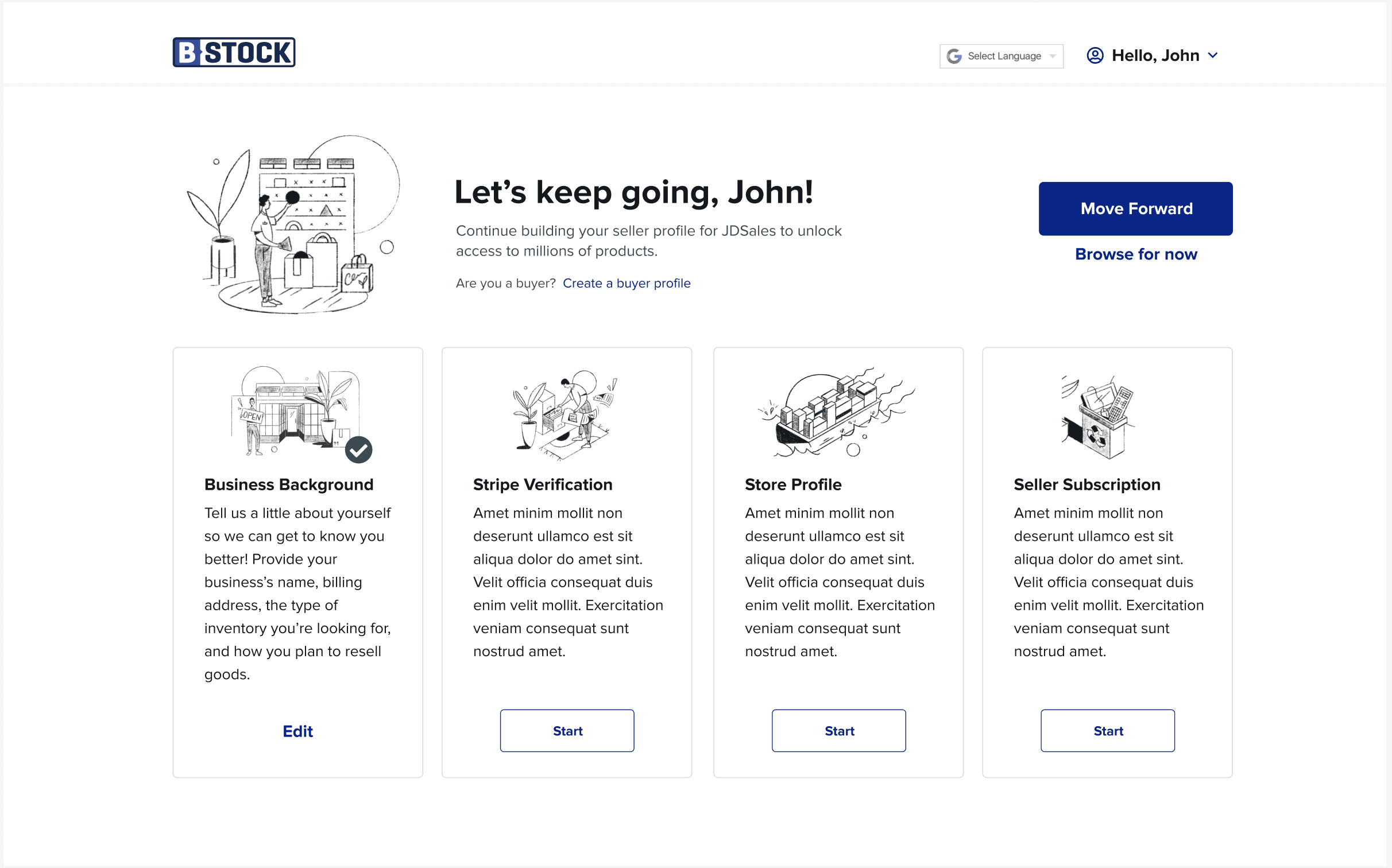
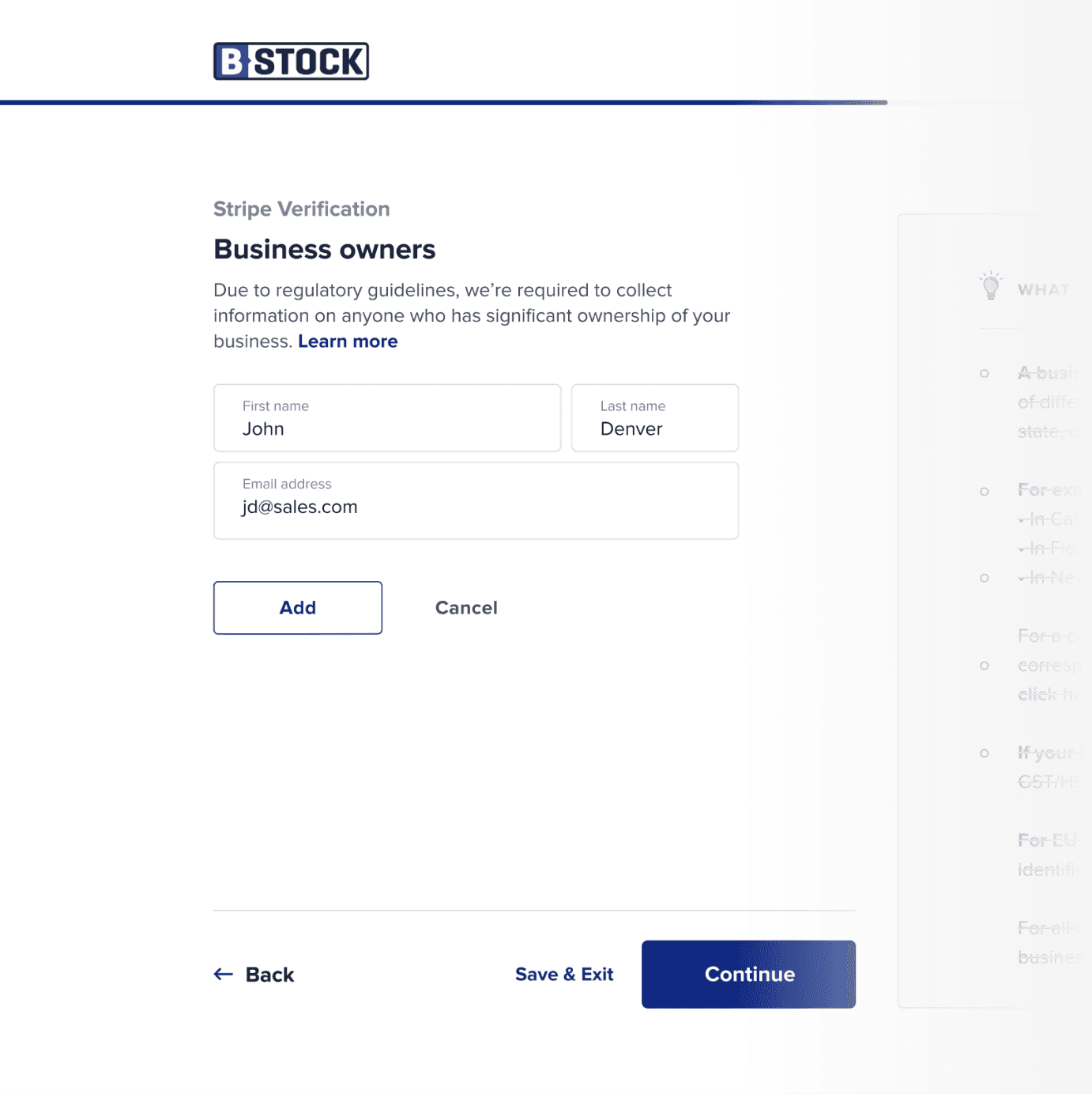
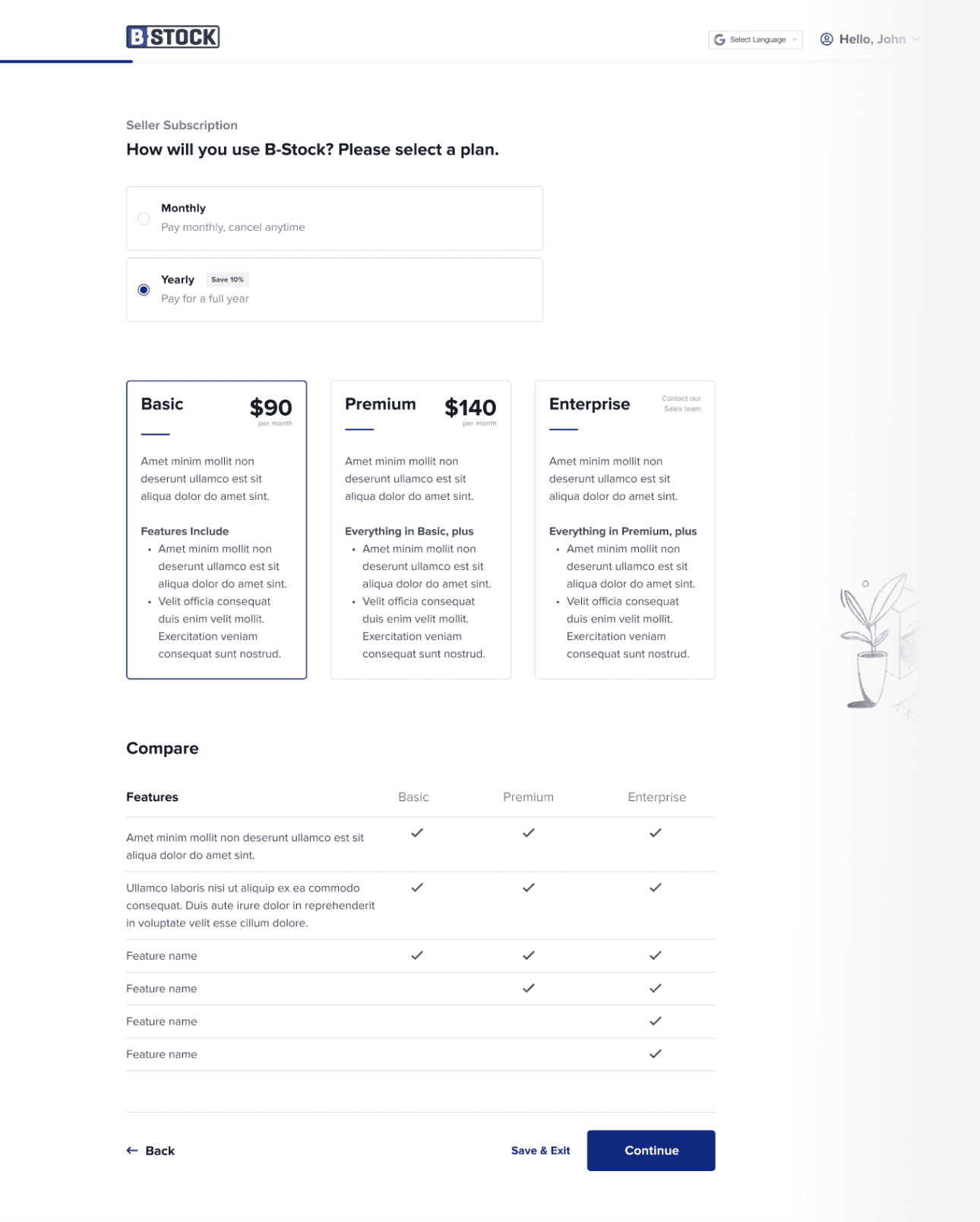
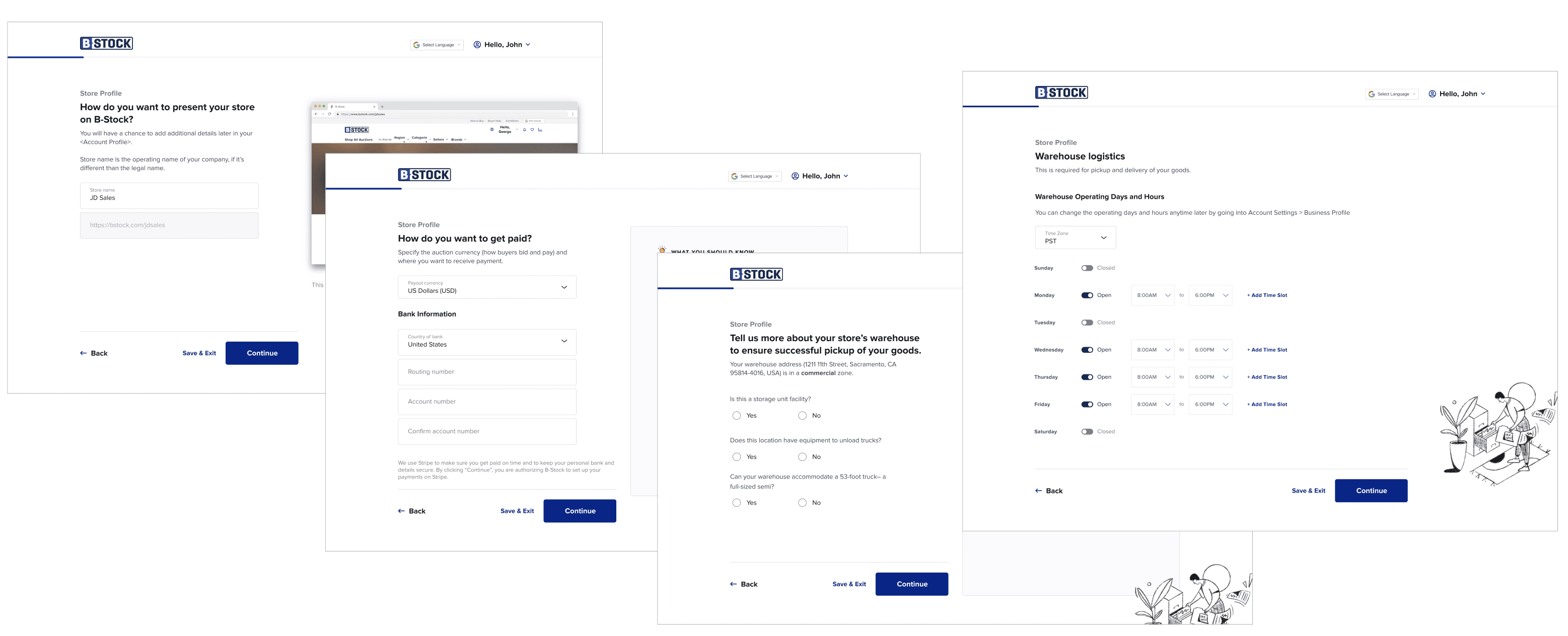
While initially architected for buyers, I designed the modular framework to be flexible enough to handle Seller Onboarding as well. By swapping buyer-specific modules for seller-specific ones—such as Storefront Setup, Stripe Integrations /Payouts, and Subscriptions—we reused the core infrastructure for the entire marketplace.
The Strategy: I implemented a "Switch Flow" mechanism within the dashboard, allowing users to pivot between funnels mid-stream. More importantly, this architecture allowed us to consolidate businesses that functioned as both Buyers and Sellers into a single unified account.
The Value: Previously, these "Hybrid" users were forced to maintain two separate company entities in our system. By designing a flexible account structure, we enabled a single business to manage both sides of their operation from one place. This architectural reuse saved months of engineering time and provided a seamless, professional experience for our most sophisticated enterprise clients.

Impact & Results: Transforming the Marketplace Engine
The redesign of the onboarding experience represented a fundamental shift in how the marketplace facilitated business entry and operational scalability.
1. Funnel Performance & Velocity
10-Fold Increase in Onboarding Conversion Rate: The transition from a fragmented legacy flow to a modular, progress-tracked system eliminated the "navigational fog" that previously caused massive user drop-offs.
Compressed Time-to-Complete (48 Hours to 14 Minutes): Automated, real-time validation reduced the time required to become "Verified-Buyer" by over 99%.
80% Reduction in Onboarding Support Volume: Proactive logistics clarity and self-service profile management eliminated the primary drivers of support tickets, significantly reducing the manual operational load.
2. Strategic Pipeline Activation
Market Democratization: Abstracting institutional B2B complexity into a guided experience lowered the barrier to entry for the entire buyer spectrum, transforming the funnel from a restrictive filter into a market accelerator.
Elimination of "Intent Decay": A single-session path to completion synchronized peak user motivation with the ability to transact, removing the "cooling-off period" of the legacy review process and injecting immediate demand into the bidding ecosystem.
3. Operational & Financial Integrity
Dynamic Compliance & Legal Validity: The platform evolved from manual, static document submission to a dynamic system that programmatically generates 100% compliant Resale Certificates (RCs). This ensured audit-ready accuracy across a diverse marketplace of Fortune 500 sellers.
Removal of Post-Win Friction: Centralizing "last-mile" logistics constraints at the account level eliminated repetitive administrative hurdles for winners. This structural shift ensured consistent fulfillment accuracy and protected margins from costly re-delivery fees.
4. Unified Enterprise Architecture
Unified Enterprise Account Model: The implementation of a hybrid account architecture allowed entities to operate as both Buyers and Sellers under a single identity, eliminating data fragmentation and providing a unified view of high-value participants.
Enterprise-Grade Multi-User Support: The shift to an organizational account structure enabled delegated workflows and team collaboration, moving the platform beyond solo-user limitations to support large-scale corporate clients.
Operational Flexibility via Modular Framework: The transition to a modular architecture replaced rigid, linear flows with logic-driven steps, creating a sustainable infrastructure for regional adjustments and functional updates without system overhauls.